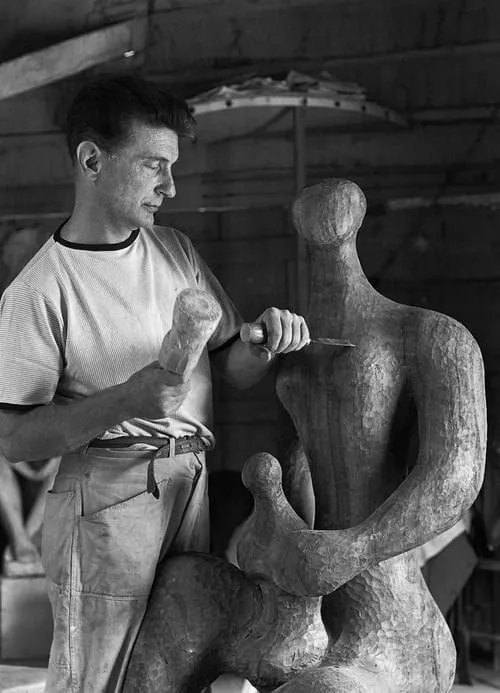
Bruno Giorgi (1905–1993) was a Brazilian sculptor renowned for his contributions to modernist public art in Brazil. Born in Mococa, São Paulo, he moved with his family to Rome in 1911, where he studied drawing and sculpture in the 1920s. During his time in Italy, Giorgi became involved in anti-fascist movements, leading to his imprisonment in 1931. After serving four years of a seven-year sentence, he was extradited to Brazil in 1935 through the intervention of the Brazilian ambassador. In 1937, he studied at the Académie de la Grande Chaumière and the Ranson Academy in Paris, where he was mentored by Aristide Maillol and interacted with artists like Henry Moore and Marino Marini. Returning to Brazil in 1939, Giorgi became an integral part of the modernist movement, collaborating with artists such as Mário de Andrade and Lasar Segall. His notable works include Os Candangos (1959), an eight-meter-tall bronze sculpture in Brasília's Praça dos Três Poderes, symbolizing the unity of Brazil's three governmental powers, and Meteoro (1968), a marble sculpture representing the harmony among the five continents, situated in the reflecting pool of the Palácio Itamaraty. Giorgi's sculptures are characterized by their abstract forms, harmonious lines, and integration with architectural spaces, solidifying his legacy as a pivotal figure in Brazilian modern art.